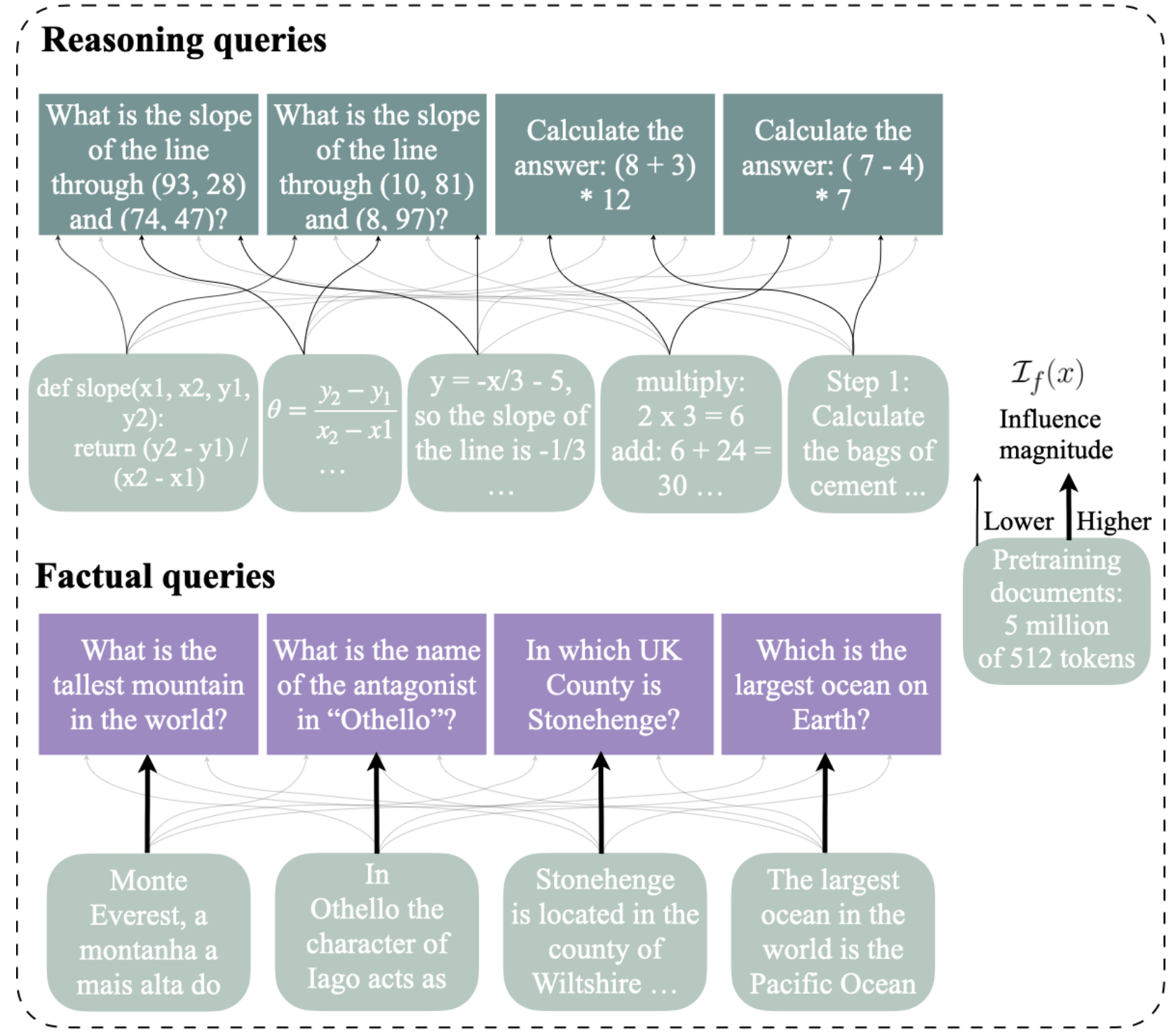
The capabilities and limitations of Large Language Models have been sketched out in great detail in recent years, providing an intriguing yet conflicting picture. On the one hand, LLMs demonstrate a general ability to solve problems. On the other hand, they show surprising reasoning gaps when compared to humans, casting doubt on the robustness of their generalisation strategies.
We study what kind of generalisation strategies LLMs employ when performing reasoning tasks by investigating the pretraining data they rely on. For two models of different sizes (7B and 35B) and 2.5B of their pretraining tokens, we identify what documents influence the model outputs for three simple mathematical reasoning tasks and contrast this to the data that are influential for answering factual questions.
We find that, while the models rely on mostly distinct sets of data for each factual question, a document often has a similar influence across different reasoning questions within the same task, indicating the presence of procedural knowledge. Our findings indicate that the approach to reasoning the models use is unlike retrieval, and more like a generalisable strategy that synthesises procedural knowledge from documents doing a similar form of reasoning.

Twitter
Facebook
Reddit
LinkedIn
Google+
StumbleUpon
Pinterest
Email